
Reference
The Sri Lanka National Annex to Eurocode 2: every value that differs from the recommended
Every value of NA to SLS EN 1992-1-1:2013 that differs from the CEN recommended values, from the 0.85 concrete factor to bar spacing and column steel.
- Reading time
- 5 minutes
- Standard
- EN 1992-1-1 with the Sri Lanka NA
- Calculator
- Slab
- Updated
On this page 8 sections
Eurocode 2 leaves a number of values for each country to decide: the Nationally Determined Parameters (NDPs). Each country publishes them in a National Annex. In Sri Lanka that is the NA to SLS EN 1992-1-1:2013, amended by AMD 522:2019.
Most of its values are the ones EN 1992-1-1 recommends. This page lists the ones that are different, as the calculator applies them, with the clause each belongs to. Every value the calculator takes from an annex is marked NDP on the calculation sheet, with the row of the annex it comes from.
The changes that matter most
- Concrete strength factor
- 0.85
- αcc, against 1.0 recommended: every fcd is 15 % lower
- Crack width limit
- 0.3 mm
- wmax for every exposure class
- Slab bar spacing
- 3h ≤ 300 mm
- main bars, against 3h ≤ 400 mm
- Column minimum steel
- 0.004 Ac
- twice the recommended 0.002 Ac
Materials
| Clause | Parameter | Recommended | Sri Lanka |
|---|---|---|---|
| 3.1.6(1)P | , long-term factor on the concrete strength | 1.0 | 0.85 |
| 3.2.2(3)P | upper limit of | 600 MPa | 500 MPa |
The factor reduces the design strength of the concrete, . With 0.85, C30/37 concrete has = 17.00 MPa instead of 20 MPa. The partial factors themselves, and , are the recommended ones.
The cut is the same share for every class, so it is largest in absolute terms for the strongest concretes. Both sets of values, as the calculator's material step works them out:
Design compressive strength for each class
fcd = αcc fck / γC with γC = 1.5. The National Annex choice of αcc changes every concrete calculation that follows.
- Recommended, αcc = 1.00
- Sri Lanka, αcc = 0.85
Show the numbers
| Recommended, αcc = 1.00 (MPa) | Sri Lanka, αcc = 0.85 (MPa) | |
|---|---|---|
| C20/25 | 13.33 | 11.33 |
| C25/30 | 16.67 | 14.17 |
| C30/37 | 20.00 | 17.00 |
| C35/45 | 23.33 | 19.83 |
| C40/50 | 26.67 | 22.67 |
| C45/55 | 30.00 | 25.50 |
| C50/60 | 33.33 | 28.33 |
Analysis
| Clause | Parameter | Recommended | Sri Lanka |
|---|---|---|---|
| 5.5(4) | in the redistribution limit, | 0.44 | 0.4 |
| 5.5(4) | , for concrete above C50/60 | 0.54 | 0.4 |
| 5.1.3(1)P | load arrangements for continuous members | alternate and adjacent spans loaded | the same, or all spans loaded with a 20 % cut in the support moments where the annex's conditions are met |
The smaller allows a little more redistribution of moment, and a slightly deeper neutral axis, before compression steel is needed. The simplified load arrangement for slabs is a welcome short cut; the calculator checks its conditions (one of them is the area of the bay, which is why it asks for the slab width) and says which arrangement it used.
Serviceability
| Clause | Parameter | Recommended | Sri Lanka |
|---|---|---|---|
| 7.3.1(5) | , crack width limit | 0.4 mm (X0, XC1), 0.3 mm (others) | 0.3 mm for every class |
| 7.4.2(2) | cap on the factor | none | 1.5 |
Detailing of slabs and beams
| Clause | Parameter | Recommended | Sri Lanka |
|---|---|---|---|
| 9.3.1.1(3) | largest spacing, main bars in slabs | mm | mm |
| 9.3.1.1(3) | largest spacing, secondary bars | mm | mm |
| 9.3.1.1(3) | near concentrated loads, secondary bars | mm | mm |
| 9.2.1.2(1) | , top steel at end supports for partial fixity | 0.15 | 0.3 |
| 9.2.1.4(1) | , bottom steel continued to end supports | 0.25 | 0.3 |
| 9.2.2(8) | spacing of the legs of links across a beam | mm | also, no tension bar more than 150 mm from a leg |
The tighter slab spacings matter in practice: a 200 mm slab may not use bars wider apart than 300 mm under the Sri Lanka annex, against 400 mm in the recommended values.
Columns
| Clause | Parameter | Recommended | Sri Lanka |
|---|---|---|---|
| 9.5.2(1) | smallest longitudinal bar | 8 mm | 12 mm |
| 9.5.2(2) | minimum steel, as a share of | 0.002 | 0.004 |
| 9.5.2(3) | maximum steel, away from laps | 0.04 | 0.06 |
| 9.5.2(3) | maximum steel, at laps | 0.08 | 0.10 |
Punching and footings
| Clause | Parameter | Recommended | Sri Lanka |
|---|---|---|---|
| 6.4.5(3) | at the column face | ||
| 9.8.2.1(1) | smallest bar in a footing | 8 mm | 10 mm |
The Sri Lanka annex prints the column face limit as , the form the recommendation took before the 2010 corrigendum to EN 1992-1-1; the corrected recommended value is . The calculator uses the annex as printed for Sri Lanka designs, and the corrected value for the recommended set.
What stays at the recommended values
Everything else is the same as the recommended values, including the partial factors, the shear constants , and , the cover allowances, the strut angle range, and the span to depth factors .
Other National Annexes
The calculator also offers the UK annex (the first edition, 2005, of the UK National Annex to BS EN 1992-1-1). The Sri Lanka annex follows it closely: the same α_cc of 0.85, the same redistribution constants, the same load arrangement options word for word, the same 0.3 mm crack width and the same cap of 1.5 on A_s,prov/A_s,req. The main differences are that the UK keeps the recommended slab bar spacings and column steel limits, sets β₁ = 0.25, allows 65 mm (not 75 mm) for concrete cast against soil, and takes the cover for durability from BS 8500, where a stronger concrete allows a smaller cover.
There are also the CEN recommended values, used in countries without an annex of their own, and an Another National Annex option where you type the values of any annex yourself; they are then printed on the calculation and the PDF under the name you give. More annexes will be added as the published documents are checked value by value.
Open the calculator and switch the annex between Sri Lanka and the recommended values to see which steps change.
Read next
-
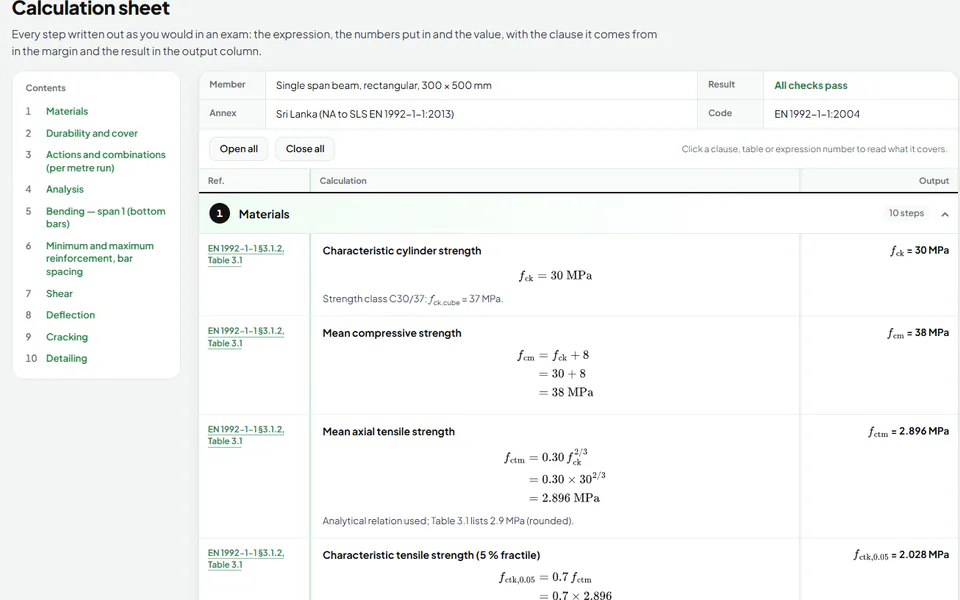 Calculator guide
How to use the Eurocode 2 calculator: a getting-started guide
A tour of the free Eurocode 2 calculator: choosing the member and National Annex, entering loads, reading the checks, and downloading the PDF.
-
 Reference
From BS 8110 to Eurocode 2: what changes for reinforced concrete design
Moving from BS 8110 to EN 1992-1-1: concrete strength, partial factors, loads, bending, shear, deflection, cover and columns compared side by side.
-
 Design guide
Deflection and crack control to Eurocode 2: span/effective depth and Tables 7.2N and 7.3N
How Eurocode 2 checks deflection by the span to effective depth ratio (7.16a, 7.16b) and cracking by bar size and spacing, with worked examples.